

Emotional Support Animals and Psychiatric Service Animals: What’s the Difference?
- Published on:
- By: ASP Team
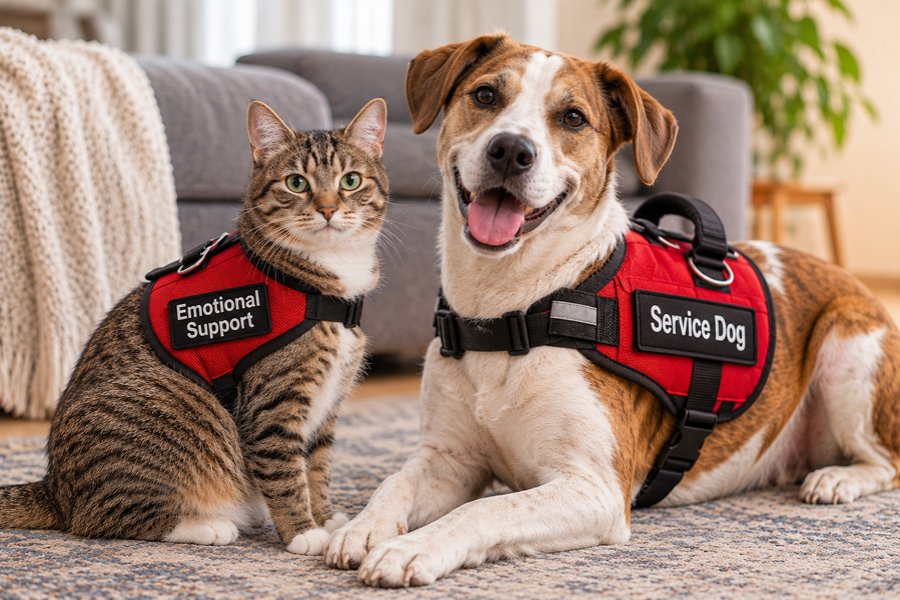
Emotional support animals (ESAs) and psychiatric service animal (PSAs) both help people living with mental health conditions, but they aren’t the same thing. An ESA helps by being with you and doesn’t need special training. A PSA is a service animal trained to perform specific tasks related to a psychiatric disability. Under federal law, a psychiatric service animal is typically a service dog.
That difference in training changes where each animal can go and which protections apply, from housing to restaurants to airlines. Here’s how each one works.
Key Takeaways
- PSAs are typically service dogs. A psychiatric service animal is trained to perform specific tasks for a psychiatric disability. An ESA helps by being with you and doesn’t need task training.
- Training is the dividing line. Task training makes a dog a service dog. A vest, letter, certificate or registration doesn’t, and no official registry exists for either one.
- Public access differs. Service dogs can generally go where the public goes under the ADA. ESAs generally can’t, though some state and local laws offer more protection.
- Both can have housing protections. The Fair Housing Act can cover ESAs and service dogs, and a housing provider may ask for reliable documentation when your need isn’t obvious.
- Air travel differs too. Airlines follow Department of Transportation rules for trained service dogs. Most treat ESAs as pets.
- An ESA can become a service dog. An ESA can become a service dog, but only if it’s a dog, it’s suited to the work and it’s trained to perform tasks tied to your disability.
Get Your ESA Today

What's the Difference Between Psychiatric Service Animals and Emotional Support Animals?
The easiest way to understand the difference between an ESA and a service animal is to compare their purpose, training, and legal protections.
| Feature | psychiatric service animal (PSA) | emotional support animal (ESA) |
|---|---|---|
| Primary purpose | Performs trained tasks related to a disability | Provides emotional comfort or support |
| Specialized task training | Required | Not required |
| Qualifying animals | Dogs under the ADA, with separate provisions for certain trained miniature horses | Dogs, cats and certain other animals |
| Type of disability | Qualifying psychiatric disabilities | Qualifying disability-related needs |
| ADA public access | Generally protected | Not generally protected |
| FHA housing accommodations | May be protected | May be protected |
| Airline service animal protections | Qualifying trained dogs are recognized | Not recognized as service animals under federal airline rules |
| Clinical letter for public access | Not required under the ADA | Does not establish ADA public access |
| Federal certification requirement | Not required | Not required for FHA housing protections |
| Professional training program | Not required, but task training is necessary | Not required |
The appropriate type of assistance animal depends on your individual circumstances, disability-related needs, and the work or support the animal provides.
What Is a Service Animal?
A psychiatric service animal (PSA), sometimes called a psychiatric service dog (PSD), is a service dog trained to perform tasks that assist someone with a psychiatric disability.
Service dogs may assist individuals living with conditions such as post-traumatic stress disorder (PTSD), anxiety disorders, depression, or other psychiatric disabilities.
However, having a diagnosis alone doesn’t establish that someone needs a service dog.
The person’s disability-related needs and the dog’s trained tasks are what matter.
Examples of Psychiatric Service Dog Tasks
A PSD may be trained to:
- Interrupt specific behaviors associated with psychiatric symptoms.
- Recognize signs of an approaching panic episode and perform a trained response.
- Retrieve medication or another needed item.
- Wake a handler from certain recurring nightmares.
- Guide a handler toward a designated exit during a psychiatric episode.
- Perform trained grounding actions when needed.
These are examples, not tasks every PSD must perform.
A service dog’s training should address the individual handler’s needs.
What Makes a Dog a Service Animal?
Three factors are particularly important:
- The handler has a qualifying disability.
- The dog has been individually trained to perform specific disability-related tasks.
- The dog meets applicable behavior and control requirements.
A dog’s friendly temperament or comforting presence alone does not establish service animal status.
The defining feature is what the dog has been trained to do.
What Is an Emotional Support Animal?
An emotional support animal provides comfort or support that helps alleviate one or more effects of a person’s disability.
Unlike a service dog, an ESA doesn’t need to perform specialized trained tasks.
A person living with a qualifying mental health disability may benefit from an animal’s companionship, presence, or the daily routine involved in caring for it.
For example, someone experiencing significant anxiety may find that their dog’s presence offers reassurance during difficult periods.
An ESA can also be a cat or another type of animal, depending on the circumstances and applicable housing requirements.
Is an Emotional Support Animal a Service Animal?
Not under the ADA.
The ADA distinguishes trained service dogs from animals whose primary function is to provide comfort through their presence.
However, this doesn’t mean an ESA has no legal protections.
Under the Fair Housing Act, an ESA may be considered an assistance animal when it supports an eligible person’s disability-related needs.
How the Rules Differ for ESAs and Service Dogs
The rules depend on where you’re going. Public places, housing, air travel and work each follow a different law. This section reflects the rules as of October 2026, so check the source for anything time-sensitive.
Public Places
Under the Americans with Disabilities Act (ADA), service dogs can generally go wherever the public can, including restaurants, stores, hotels and hospitals. A business can’t ask for documentation, an ID card or proof of certification.
When a dog’s role isn’t obvious, staff may ask whether the dog is required because of a disability and what work or task it has been trained to perform. They can’t ask about your diagnosis or ask the dog to demonstrate a task.
ESAs don’t have this access. A business may allow one under its pet policy, but the ADA doesn’t require it. Some state and local laws offer more protection, so check yours. An ESA letter doesn’t create public access rights.
Housing
The Fair Housing Act (FHA) can cover both service dogs and ESAs. If you have a disability, you can ask for a reasonable accommodation to live with your animal in housing that restricts pets.
Requests to waive pet rules and fees for a trained service dog are generally treated as reasonable. For an ESA, it’s less certain: HUD’s enforcement now focuses on trained animals, so whether a housing provider waives pet fees for an ESA may depend on your state’s law. You can still be responsible for damage the animal causes.
When your disability or your need for the animal isn’t obvious, a housing provider may ask for reliable supporting information, such as documentation from a licensed healthcare professional. Some states bar housing providers from asking for your diagnosis or medical records. A housing provider can say no to a request for a service dog or an ESA when granting it would create an undue burden or fundamentally change how the housing operates, or when the animal poses a direct threat or causes substantial damage that can’t be reduced.
HUD’s May 2026 enforcement memo focuses on animals individually trained to do work or tasks, so the training difference matters more in housing than it used to. State and local fair housing laws didn’t change. For the details, see our guides to HUD’s 2026 change, how the FHA, Section 504 and the ADA apply and Section 504 and ESAs in housing.
Air Travel
Under the Department of Transportation (DOT) final rule from December 2020, airlines treat trained service dogs, including psychiatric service dogs, as service animals. They may ask for DOT forms covering the dog’s health, behavior and training. On flights of eight hours or longer, they may also ask for a form about the dog’s ability to relieve itself in a sanitary way.
Airlines aren’t required to treat ESAs as service animals, and most treat them as pets. That means pet fees, size limits and carrier rules. An ESA letter doesn’t change that. Policies vary by airline, so check yours before you book.
Work
ADA Title I doesn’t limit the type of animal an employer can consider. A request to bring a service dog or an ESA to work is handled as a possible reasonable accommodation.
It’s decided case by case, and it isn’t automatic. Employers can weigh factors like safety and how the animal would affect the workplace.
Can an ESA Become a Service Dog?
Yes, if it’s a dog and it’s trained to perform tasks tied to your disability. Training changes the category. Paperwork doesn’t. A vest, an online certificate or an ESA letter won’t turn an ESA into a service dog.
Many people start with an ESA for housing, and later look into a psychiatric service dog when they need more than comfort, such as help during panic episodes. An ESA doesn’t need task training, though good manners at home still matter. Not every ESA makes a good service dog. The training takes time, and the dog needs the right temperament.
What Training Does a Service Dog Need?
Under the ADA, a service dog must be individually trained to do work or perform tasks directly related to your disability. For a psychiatric disability, those tasks might include:
- Interrupting a panic episode or a harmful behavior.
- Reminding you to take medication.
- Waking you from a nightmare.
- Guiding you to an exit or to a trusted person.
The ADA doesn’t require a professional training program. You can train your own dog or work with a trainer. The dog does have to perform its tasks reliably and behave in public, which means being housebroken and staying under your control. For more examples, see what tasks a psychiatric service dog can be trained to perform.
Do Service Dogs and ESAs Need Registration, Certification or a Letter?
No. Federal law doesn’t require registration or certification for a service dog or an ESA, and no official registry exists for either one. A purchased certificate, ID card, vest or registration number doesn’t establish an animal’s legal status.
For a service dog, what counts is task training. The ADA doesn’t require a letter for public access, and a letter doesn’t replace the training. For an ESA, a letter from a licensed provider can document your disability-related need when you ask for a housing accommodation and the need isn’t obvious. It doesn’t certify the animal.
A letter also doesn’t guarantee an outcome. A housing provider reviews each request under fair housing law, and some state laws add their own rules. If a site offers instant registration or a certificate for a fee, treat it as a warning sign.
Which Is Right for You: An ESA or a Service Dog?
It depends on what your animal does for you and where you need it. Neither option is better. They do different things.
A few questions to help you decide:
- Does your animal help by being with you, or by doing something specific on cue?
- Is your dog trained to perform that task reliably, including in public?
- Where do you need your animal most: at home, in public places, or both?
- Are you ready for the ongoing time and care a trained service dog requires?
An ESA may fit when your animal’s companionship eases the effects of a disability and housing is your main need. A service dog may fit when your dog is trained to perform tasks that reduce the effects of a psychiatric disability and you want access to public places.
If you aren’t sure, a licensed mental health professional can talk it through with you. They look at your history, your daily challenges and your needs, then decide whether documentation is clinically appropriate. Documentation doesn’t establish a dog’s training or create public access rights.
American Service Pets connects patients with licensed mental health professionals in the patient’s state. If you’d like to explore an ESA evaluation, you can start a health assessment, and the provider decides whether a recommendation is appropriate.
Frequently Asked Questions
Do Emotional Support Animals count as service animals?
No. Under the ADA, a service animal is a dog individually trained to perform tasks related to a person’s disability. Providing comfort through companionship isn’t enough, so an emotional support dog isn’t a service dog. An ESA can still have housing protections under the Fair Housing Act.
Is a Psychiatric Service Animal the same as an ESA?
No. A psychiatric service animal is a service dog trained to perform specific tasks for a mental health disability. An ESA helps by being with you and doesn’t need task training. The training is also why the two have different public access and air travel rules.
Which is better, a service dog or an Emotional Support Animal?
Neither. They do different things. A service dog performs trained tasks and generally has public access rights. An ESA provides comfort and has housing protections. The better fit depends on what you need your animal to do and where you need it.
Can an ESA become a service dog?
Yes, if it’s a dog that’s suited to training and is individually trained to perform tasks directly related to your disability. A letter, vest or registration doesn’t do this on its own. Not every ESA is a good candidate, since the training takes time and the dog needs the right temperament.
Can you just say your dog is an Emotional Support Animal?
No. Saying it isn’t enough. A housing provider can ask for reliable documentation when your disability or your need for the animal isn’t obvious. Some states also have laws against misrepresenting an animal as a service or assistance animal.
Do I need to register my dog or buy a vest or ID card?
No. Neither the ADA nor the Fair Housing Act requires registration, certification, a vest or an ID card, and none of those items establishes an animal’s legal status. Be cautious of any site that sells instant registration.
Can a psychiatric service dog help with anxiety?
It can, if your anxiety is a disability and the dog is trained to perform tasks that help with it. For example, a dog might learn a specific response to the signs of an approaching panic episode. Having anxiety alone doesn’t make a dog a service dog. The training does.
Can my ESA fly with me?
Most airlines treat ESAs as pets, so pet fees, size limits and carrier rules apply. Federal rules don’t recognize ESAs as service animals for air travel. Trained service dogs follow separate Department of Transportation (DOT) rules. Check your airline’s current policy before you book.
Understanding Your Assistance Animal Options
Service dogs and emotional support animals can both play important roles in supporting people with disabilities, but their responsibilities and legal protections are different.
Service dogs perform trained disability-related tasks. ESAs provide emotional comfort and companionship without specialized task training.
Both may be considered assistance animals under applicable housing requirements, while trained service dogs generally have broader federal protections for public access and air travel.
If you’re exploring whether assistance animal documentation may be appropriate, American Service Pets can help connect you with a licensed provider for an individualized clinical evaluation.
Related Reading

The benefits of an Emotional Support Animal certification and a Psychiatric Service Dog certification are drastically different. Fortunately for you, American Service Pets’ network of active board certified doctor or other licensed mental health providers can help you find the right path to certification. To find out whether you need an ESA or PSD letter, take our easy, three-step Pet Owner Survey!
More Great Resources